A New Generation of Precision
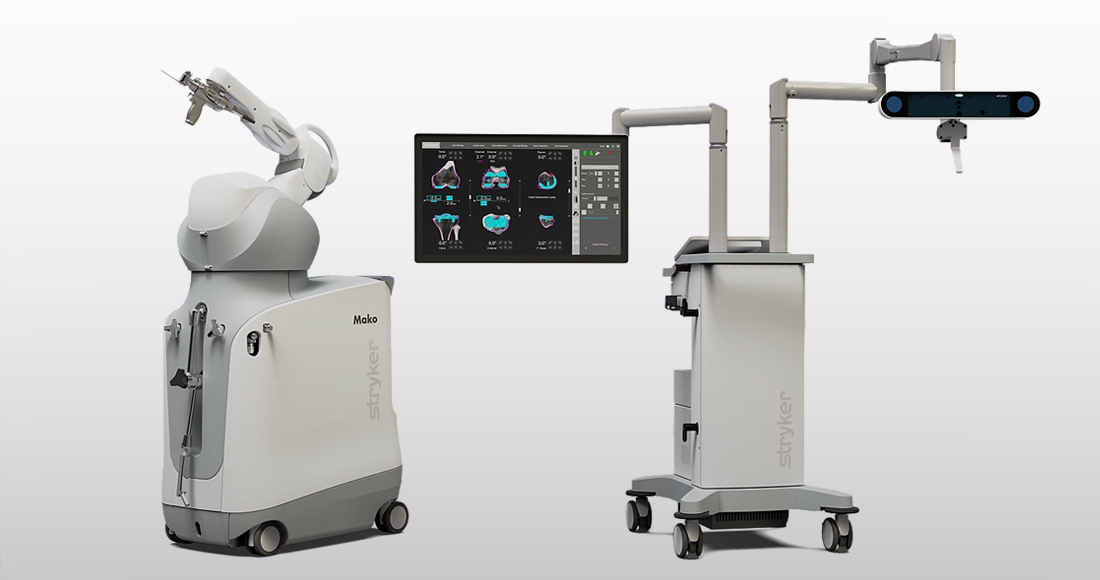
The system now in use at the Schaumburg Surgery Center is Stryker’s fourth-generation Mako, which became commercially available in 2025. It is a single robotics platform spanning total knee, partial knee, total hip, and spine procedures, and it integrates the company’s latest Q Guidance system. Because the upgrade includes both new hardware and new software, it is designed to serve as the foundation for future Mako advancements — meaning our patients benefit not only from today’s capabilities but from a platform built to keep improving. Worldwide, more than 1.5 million Mako procedures have now been performed across dozens of countries, giving the technology a substantial clinical track record.
How It Works for Knee Replacement Patients
The process begins well before the patient enters the operating room. A CT scan of the knee is used to generate a detailed 3D model of each person’s unique anatomy. Dr. Obermeyer uses that model to build a surgical plan tailored to the individual — mapping implant size, position, and alignment with a level of detail that is difficult to achieve with conventional instruments alone.
During surgery, the surgeon guides the Mako robotic arm to carry out that plan. The system’s haptic technology creates defined boundaries that help keep bone preparation within the pre-planned area, protecting the surrounding ligaments and healthy tissue. For patients whose arthritis is confined to one part of the knee, this precision supports partial knee replacement, which preserves more of the natural joint; for more advanced arthritis, the same system guides total knee replacement using Stryker’s clinically established Triathlon implant.
The Benefits of Robotic-Arm-Assisted Care
Greater precision is not an end in itself — it is a means to better outcomes. In Stryker’s clinical studies, robotic-arm-assisted knee replacement with Mako has been associated with benefits such as less pain in early recovery, a reduced need for opioid pain medication, less reliance on inpatient physical therapy, shorter hospital stays, and greater protection of the soft tissues around the knee, compared with manual techniques. Individual results vary, and Dr. Obermeyer reviews what each patient can realistically expect during consultation.
Surgeon Skill, Advanced Technology
It is important to understand what robotic assistance is — and what it is not. The Mako system does not perform surgery on its own. Every plan is designed by the surgeon, and every movement of the robotic arm is directed by the surgeon’s hands. The technology is a tool that extends Dr. Obermeyer’s training and judgment, giving him real-time information and control to execute his plan with confidence and consistency.
That combination — a fellowship-trained surgeon experienced in shoulder and knee care, paired with the newest robotic platform available — is what allows the Schaumburg Surgery Center to deliver advanced joint replacement in a comfortable, efficient outpatient setting.
About Thomas Obermeyer, MD
From sports medicine and joint replacement to physical therapy, pain management, and advanced imaging, Dr. Obermeyer’s team brings subspecialized expertise and the latest technology together under one roof. To learn whether robotic-arm-assisted knee replacement may be right for you schedule a consultation today.